Skywatchers across the United States will get a rare celestial show tonight.
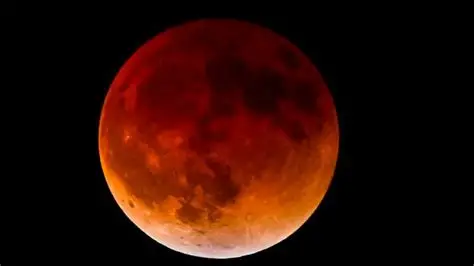
A total lunar eclipse — often called a “blood moon” — will turn the Moon a deep reddish color as it passes fully into Earth’s shadow. The event will be visible across much of North America, depending on weather conditions.
Unlike a solar eclipse, no special glasses are required. Anyone with a clear view of the night sky can watch safely.
Here’s what time it begins, when totality occurs, and why this eclipse matters.
Key Event Details
| Event | Total Lunar Eclipse (Blood Moon) |
|---|---|
| Location | Visible across much of the United States |
| Date | Tonight |
| Who is affected | Skywatchers, astronomy enthusiasts, educators |
| Current status | Eclipse scheduled; visibility depends on local weather |
| What readers should know | Safe to view with naked eye; peak totality lasts about an hour |
What Time Does the Blood Moon Eclipse Start?
The total lunar eclipse will unfold in stages.
The penumbral phase begins when the Moon enters Earth’s outer shadow. This stage is subtle and often hard to notice.
The partial eclipse begins when the Moon starts moving into the darker central shadow, known as the umbra.
Totality — when the Moon appears red — is the highlight of the night.
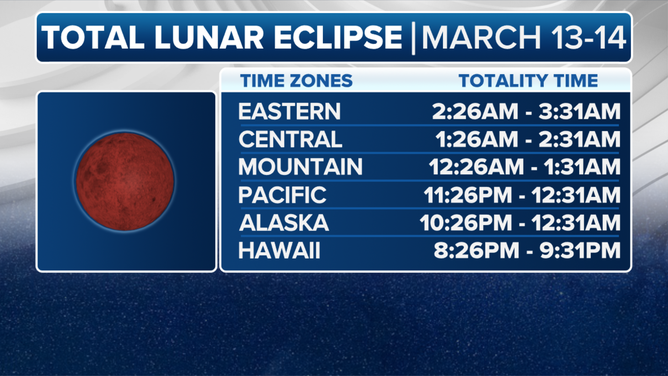
For viewers in the Eastern Time Zone:
- Penumbral eclipse begins: Around 11:00 p.m.
- Partial eclipse begins: Around 12:15 a.m.
- Totality begins: Around 1:30 a.m.
- Maximum eclipse: Around 2:00 a.m.
- Totality ends: Around 2:30 a.m.
Timings vary slightly depending on location. Viewers in Central, Mountain and Pacific time zones will see the event earlier in the evening.
NASA advises checking local listings for precise timing in specific cities.
Why the Moon Turns Red During a Total Lunar Eclipse
The “blood moon” effect happens because of how sunlight interacts with Earth’s atmosphere.
When the Moon passes fully into Earth’s shadow, direct sunlight is blocked. However, some light bends around Earth’s atmosphere and reaches the Moon.
Shorter blue wavelengths scatter, while longer red wavelengths pass through — casting a copper or red glow on the lunar surface.
“It’s the same physics that makes sunsets red,” said Dr. Noah Petro, a lunar scientist at NASA’s Goddard Space Flight Center. “During totality, the Moon is essentially lit by all the sunrises and sunsets happening on Earth at that moment.”
The exact shade can vary depending on atmospheric conditions such as dust or pollution.
Where Will the Eclipse Be Visible?
The eclipse will be visible across most of North America, weather permitting.
Parts of South America and Europe may also see portions of the event, depending on timing and local conditions.
Urban light pollution does not prevent viewing, though darker skies can enhance the experience.
Astronomers recommend heading to an open area with a clear view of the horizon.
Timeline: How the Eclipse Unfolds
Penumbral Phase
The Moon enters Earth’s outer shadow. The dimming is faint and gradual.
Partial Eclipse
A noticeable “bite” appears as Earth’s shadow moves across the Moon’s surface.
Totality
The Moon turns reddish as it is fully immersed in the umbra. This phase lasts roughly one hour.
Exit Phases
The Moon gradually brightens as it moves out of Earth’s shadow.
The entire event spans several hours from start to finish.
Official Guidance and Expert Insights
NASA encourages viewers to enjoy the eclipse without protective eyewear.
“Lunar eclipses are completely safe to observe with the naked eye,” NASA states on its website. “You don’t need any special equipment.”
Telescopes and binoculars can enhance the view, especially during totality.
Astronomy educator Derrick Pitts of The Franklin Institute notes that lunar eclipses offer a different experience compared to solar eclipses.
“You can watch the whole thing unfold slowly,” Pitts said in a previous interview. “It’s less dramatic than a solar eclipse, but in some ways more relaxing.”
Public Interest and Social Media Buzz
Search interest for “blood moon eclipse time tonight” has surged ahead of the event.
Schools and science centers are hosting viewing events, and many amateur astronomers are planning live streams.
Weather, however, remains a key factor. Cloud cover in some regions may limit visibility.
Meteorologists advise checking local forecasts before heading outside.
Why This Eclipse Matters
Total lunar eclipses do not happen every month, even though the Moon orbits Earth regularly.
The alignment of the Sun, Earth and Moon must be nearly perfect.
While lunar eclipses are not as rare as total solar eclipses, a visible total lunar eclipse across large parts of the United States remains a notable astronomical event.
For educators, it also provides a teachable moment about orbital mechanics and atmospheric science.
What Happens Next?
After tonight’s event, the next total lunar eclipse visible in North America will occur on a future date set by astronomical cycles.
NASA and major observatories typically publish eclipse calendars years in advance.
Skywatchers who miss tonight’s event will have other opportunities — though timing and visibility will vary.
Frequently Asked Questions (FAQ)
1. What time is the blood moon tonight?
Totality begins around 1:30 a.m. Eastern Time, with maximum eclipse around 2:00 a.m.
2. Do I need special glasses to watch the lunar eclipse?
No. Lunar eclipses are safe to view with the naked eye.
3. Why is it called a blood moon?
The Moon appears red due to sunlight filtering through Earth’s atmosphere during totality.
4. How long does totality last?
Totality lasts about one hour, though the full eclipse spans several hours.
5. Will the eclipse be visible everywhere in the U.S.?
Most of the United States will be able to see it, weather permitting.
6. Can I photograph the eclipse with a smartphone?
Yes, though a tripod and zoom lens may improve image quality.
Conclusion
Tonight’s total lunar eclipse offers a clear opportunity to watch a rare alignment of the Sun, Earth and Moon.
With totality lasting about an hour and no special equipment required, the blood moon is accessible to anyone with a clear sky.
Viewers are advised to check local weather conditions and timing for their region before stepping outside.
The next visible total lunar eclipse will follow its own celestial schedule — but for now, the focus is on tonight’s sky.










Leave a Comment