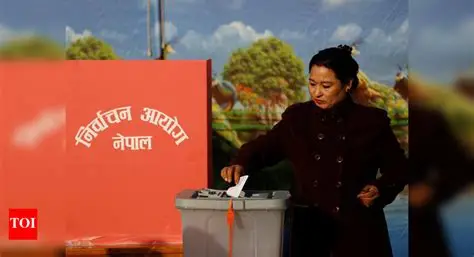
Vote counting is underway in Nepal following the recent parliamentary elections held to form a new House of Representatives. Early trends suggest a strong performance by the Rastriya Swatantra Party (RSP), which has taken the lead in dozens of constituencies. The election comes after months of political uncertainty triggered by youth-led protests that led to the dissolution of the previous parliament.
Early Results Show RSP Gaining Momentum
Preliminary vote counts indicate that the Rastriya Swatantra Party has emerged as a major contender in Nepal’s parliamentary elections. According to early figures, the party is leading in 81 constituencies across the country, suggesting a significant shift in the political landscape.
The vote tally is still ongoing, and the final outcome will only be confirmed once counting is completed in all constituencies. However, the early trends have already generated considerable attention among political observers, as the RSP appears to be performing strongly against more established parties.
The party’s early success reflects growing public support for newer political alternatives amid widespread dissatisfaction with traditional political leadership.
Proportional Representation Votes Also Favor RSP
In addition to constituency-based races, Nepal’s parliamentary system includes a proportional representation (PR) component that allows parties to secure seats based on their share of the nationwide vote.
Initial counts from the PR ballots suggest that the RSP is also performing competitively in this category. A strong showing in both constituency seats and proportional representation could significantly boost the party’s presence in the next parliament.
Political analysts note that the combination of constituency victories and PR seats could make the party a major force in shaping the future government.
Election Held After Parliament Dissolution
The election was called after Nepal’s previous House of Representatives was dissolved earlier this year following a period of political instability. The decision came in the aftermath of large-scale demonstrations led primarily by younger citizens demanding greater transparency, accountability, and reforms in governance.
The protests, widely referred to as the “Gen-Z protests,” reflected growing frustration among younger voters who felt that the existing political system was not addressing their concerns. Demonstrators called for fresh elections and significant political change.
In response to the mounting pressure, the government announced new parliamentary elections to allow voters to choose a new leadership and restore political stability.
High Voter Participation Across the Country
Election officials reported strong voter turnout in many parts of Nepal, with citizens lining up at polling stations to cast their ballots. Observers say the high participation rate reflects the public’s eagerness to influence the country’s political future after months of uncertainty.
Polling was conducted across hundreds of constituencies nationwide under the supervision of the Election Commission Nepal. Authorities implemented extensive logistical arrangements to ensure smooth voting across the country’s diverse geography, which includes mountainous regions and remote rural areas.
International and domestic observers also monitored the election process to ensure transparency and fairness.
Political Landscape in Transition
Nepal’s political environment has been undergoing rapid changes in recent years. While traditional parties have historically dominated national politics, newer groups have increasingly gained support by appealing to voters seeking reform and accountability.
The rise of parties such as the RSP indicates a broader shift in voter preferences, particularly among younger citizens and urban populations. Many voters have expressed a desire for leadership that prioritizes economic development, job creation, and improved governance.
If current trends continue, the upcoming parliament could be more politically diverse than previous ones, potentially leading to coalition negotiations and new alliances among parties.
Final Results Yet to Be Confirmed
Despite the strong early performance by the RSP, election officials emphasize that the counting process is still ongoing. Results from several constituencies are yet to be finalized, and the final seat distribution will depend on the completion of vote counting across the country.
Political parties are closely monitoring the results as they prepare for possible coalition discussions once the full outcome becomes clear.
Conclusion
As vote counting continues in Nepal’s parliamentary elections, the Rastriya Swatantra Party has taken an early lead in dozens of constituencies and is performing strongly in proportional representation votes. The election, held after the dissolution of parliament following youth-led protests, marks a crucial moment in Nepal’s political transition. While final results are still awaited, early trends suggest that the country’s political landscape may be undergoing a significant shift.









Leave a Comment